Optical Computing and Sensing in Complex Media

Research Topics

Extreme Learning Machines and Reservoir Computing

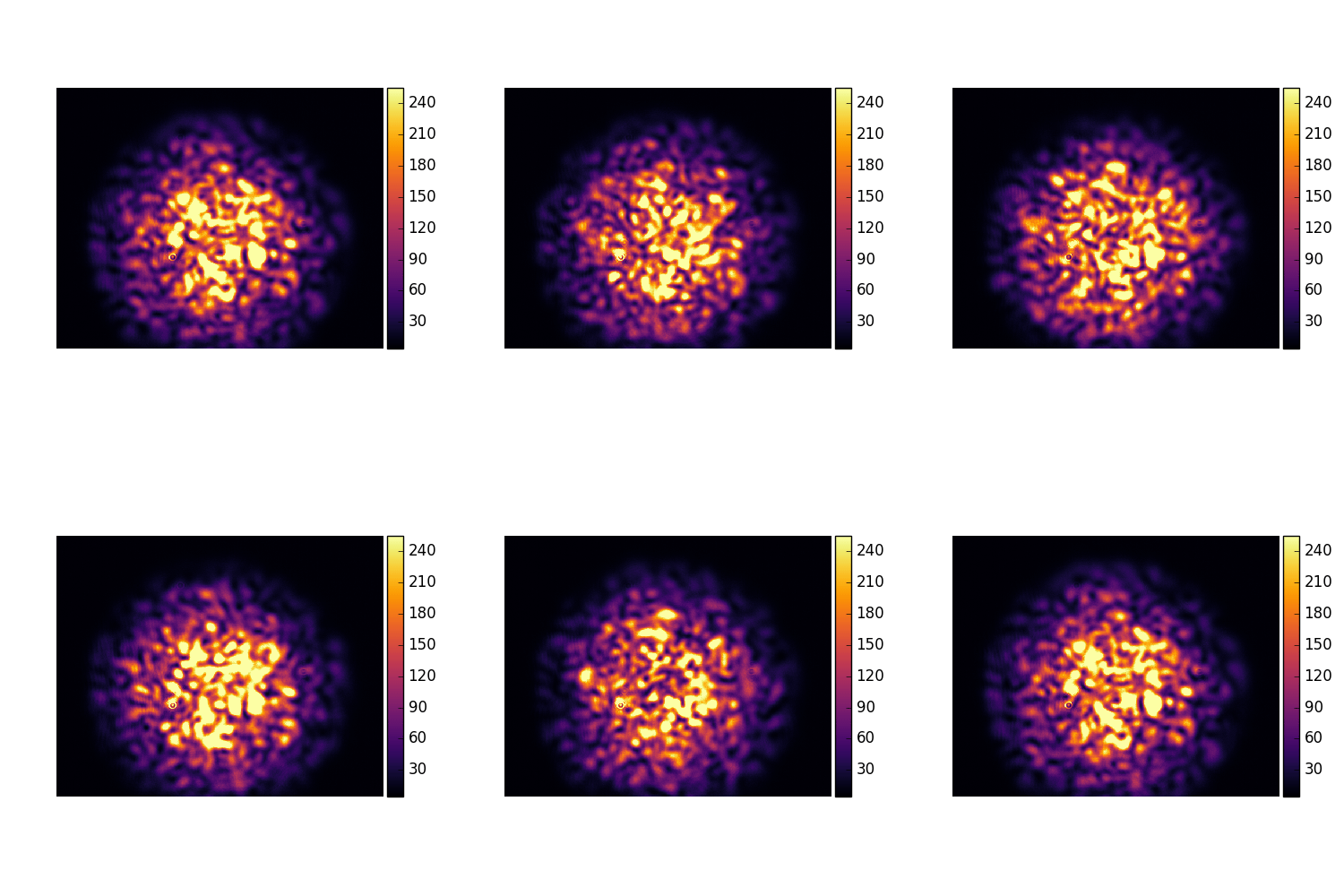
In this research line, we explore optical implementations of Extreme Learning Machines (ELMs) and Reservoir Computing (RC) using nonlinear media. By leveraging the complex dynamics of light in complex media and paraxial fluids, we perform fast, energy-efficient information processing directly in the optical domain. Our goal is to develop all-optical computing platforms capable of handling tasks such as pattern recognition and signal classification, pushing the boundaries of machine learning with light-speed, hardware-based solutions.

Extreme Learning Machines and Reservoir Computing

Transmission Matrix

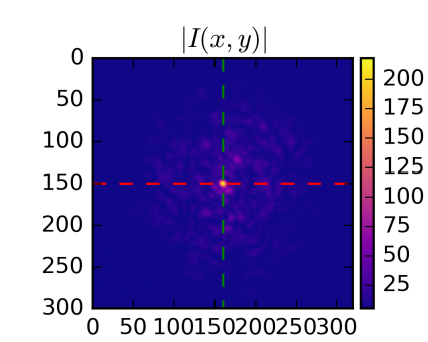
We study the Transmission Matrix (TM) of complex optical systems to understand and control light propagation through scattering or nonlinear media. By experimentally measuring the TM, we gain full knowledge of how input light fields are transformed as they travel through the medium. This allows us to shape light with high precision, enabling advanced applications such as wavefront shaping, imaging through disorder, and optical computing. Our approach combines holography, numerical modeling, and machine learning to unlock the full potential of optical systems as programmable processors.

Transmission Matrix

Distributed Optical Sensing with Event Based Cameras

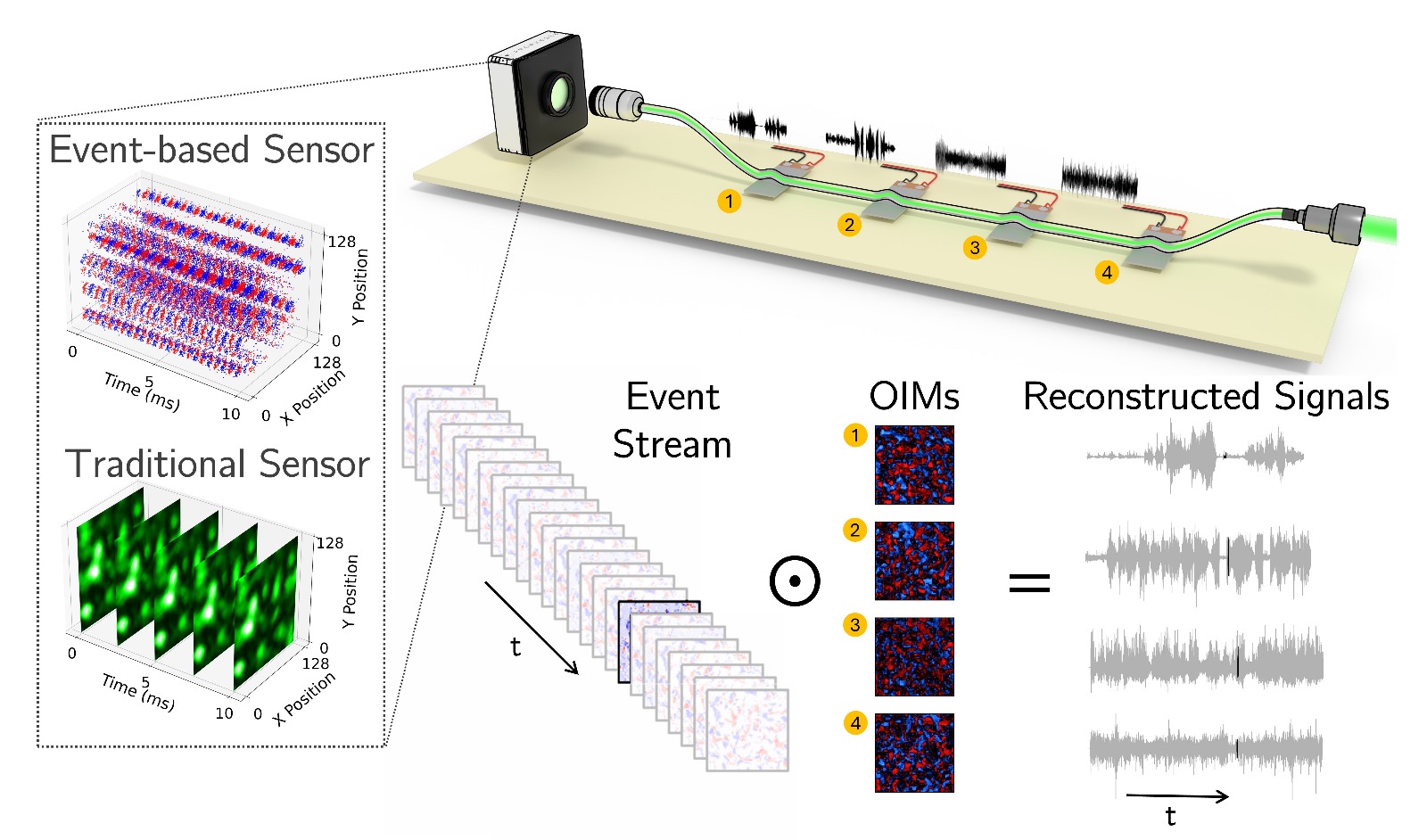
On this area, we introduce a novel sensing architecture that leverages the high-dimensionality of speckle patterns in multimode fibers in combination with event-based vision sensors to enable ultra-fast distributed acoustic sensing. Unlike traditional camera-based systems limited by low frame rates, our approach captures dynamic speckle variations at kHz acquisition rates using a low-cost setup. By applying a data-driven calibration pipeline, we compute Optimal Interrogation Modes that isolate localized deformations with centimeter-scale spatial resolution. This allows us to reconstruct independent simultaneous vibrations from four piezoelectric membranes driven with complex signals at frequencies from 350 Hz to 20 kHz. The proposed method significantly reduces crosstalk and latency, providing a compelling alternative to conventional DAS technologies.

Distributed Optical Sensing with Event Based Cameras

Enhancing Optical Sensing using Fisher Information

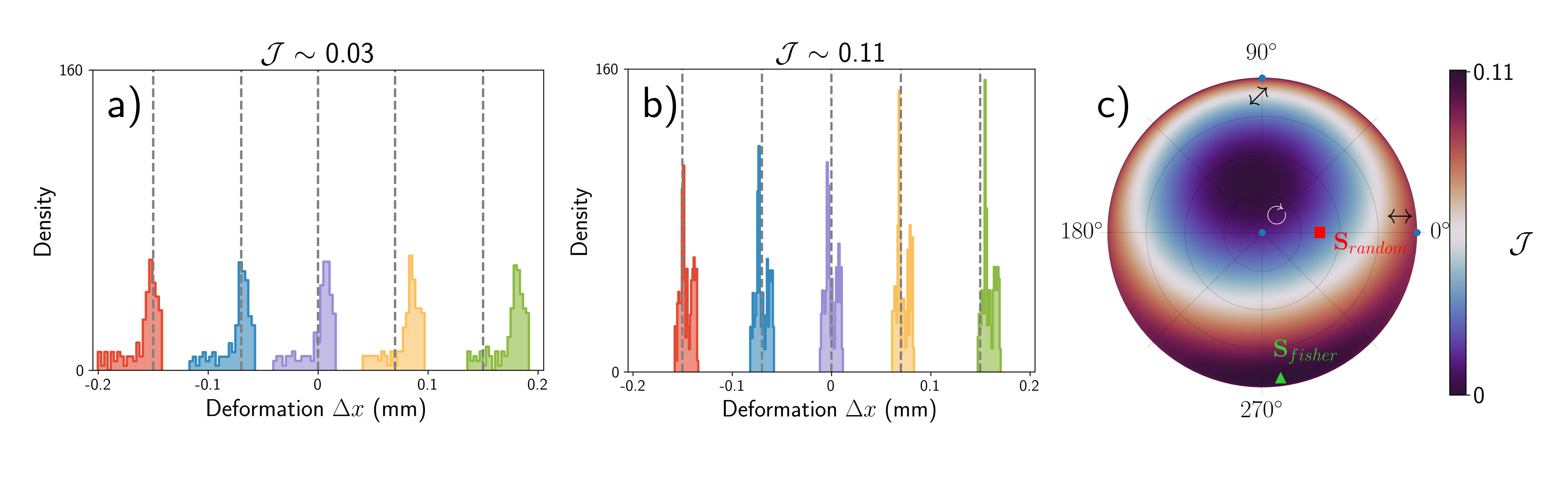
In this research, we enhance the precision of polarization-based fiber sensors by integrating Fisher Information into the sensing framework. Using the Mueller matrix formalism, we characterize how light polarization evolves inside an optical fiber and detect mechanical deformations by tracking subtle polarization changes. By identifying the input polarization state that maximizes Fisher Information, we significantly improve the sensor’s sensitivity and accuracy. This approach enables high-resolution, real-time sensing and opens new possibilities for precise optical monitoring in areas like structural health and industrial diagnostics.

Enhancing Optical Sensing using Fisher Information

Our Team

Meet the researchers working on Optical Computing and Sensing in Complex Media projects:

Dr. Nuno A. Silva

Dr. Nuno A. Silva

Postdoctoral Researcher

Dr. Tiago Ferreira

Dr. Tiago Ferreira

Postdoctoral Researcher

Dr. Catarina Monteiro

Dr. Catarina Monteiro

Postdoctoral Researcher

Dr. Pedro Jorge

Dr. Pedro Jorge

Auxiliary Professor

Joana Teixeira

Mrs. Joana Teixeira

PhD Student

Mr. Tomas Lopes

Mr. Tomás Lopes

PhD Student

Sofia Duarte

Sofia Duarte

Master Student

Journal Articles

Probing a theoretical framework for a Photonic Extreme Learning Machine

Vicente Rocha, Duarte Silva, Felipe C. Moreira, Catarina S. Monteiro, Tiago D. Ferreira, Nuno A. Silva

arXiv Preprint • 2025

Multimodal Speckle-polarization Fiber-optic Sensing for Localized and High-bandwidth Vibration Monitoring

Catarina S. Monteiro, Tomás Lopes, Joana Teixeira, Tiago D. Ferreira, Pedro A. S. Jorge, Nuno A. Silva

arXiv Preprint • 2025

Event-based Speckle Interrogation for High-Bandwidth Multi-point Optical Fiber Sensing

Tomás Lopes, Joana Teixeira, Vicente V. Rocha, Tiago D. Ferreira, Catarina S. Monteiro, Pedro A. S. Jorge, Nuno A. Silva

arXiv Preprint • 2025

High-Precision Acoustic Event Monitoring in Single-Mode Fibers Using Fisher Information

Catarina S. Monteiro, Tiago D. Ferreira, Nuno A. Silva

Optics Letters • 2025

Optical Extreme Learning Machines with Atomic Vapors

Nuno A. Silva, Vicente Rocha, Tiago D. Ferreira

Atoms • 2024

Exploring the hidden dimensions of an optical extreme learning machine

Duarte Silva, Tiago D. Ferreira, Felipe C. Moreira, Carla C. Rosa, Ariel Guerreiro, Nuno A. Silva

J. Eur. Opt. Society-Rapid Publications • 2023

Reservoir computing with nonlinear optical media

Tiago D. Ferreira, Nuno A. Silva, Duarte Silva, Carla C. Rosa, Ariel Guerreiro

Journal of Physics: Conference Series • 2022

Reservoir computing with solitons

Nuno Azevedo Silva, Tiago D. Ferreira, Ariel Guerreiro

New Journal of Physics • 2021

Master Theses

Optical Extreme Learning Machines: a new trend in optical computing

Duarte Silva

University of Porto • 2022

Awards

2º Place for Student Presentation (Poster) - Reservoir computing with nonlinear optical media

Tiago D. Ferreira

5ª 5th International Conference on Application of Optics and Photonics • 2022