Spectral Imaging
Research Topics
Advanced Spectroscopy for Industrial Applications
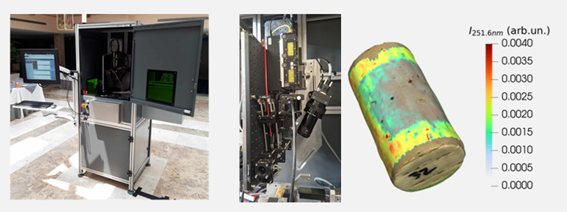
This research line focuses on the development and deployment of spectroscopy techniques, such as LIBS, Raman, XRF, and Hyperspectral for material characterization in demanding industrial environments. We develop fit-for-purpose systems that integrate spectral imaging, machine vision, and optoelectronic hardware for in-line and at-line monitoring. Our work spans several sectors, including mining, where we’ve developed LIBS systems for ore grading and lithium mapping; batteries, with published methods for lithium quantification in anode-less solid-state cells; cork industry where we created an at-line LIBS imaging system for coating inspection in cork stoppers; and in wood recycling, where we used LIBS to detect hazardous elements like Cr and Pb. These high-throughput systems support the development of modular, multimodal platforms aligned with Industry 4.0 standards. Ongoing and future efforts aim to extend these solutions to the recycling industry and other circular economy applications.
Multimodal Sensing and Data Architectures
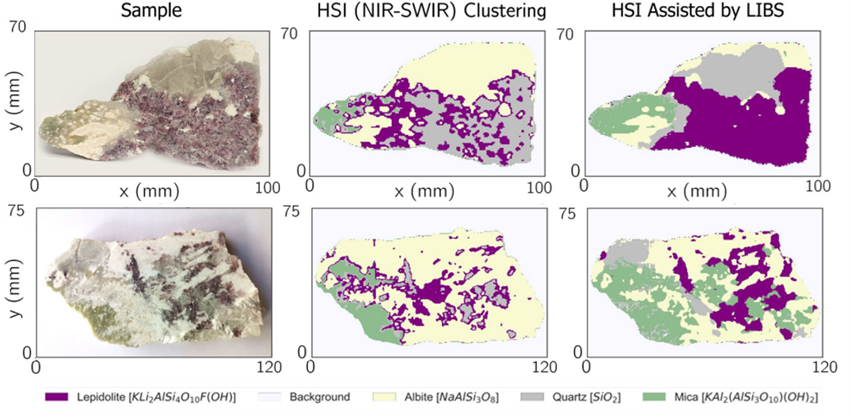
This line explores the integration of different spectral techniques using advanced data fusion, machine learning, and knowledge distillation strategies. By combining elemental and molecular information, we develop interpretable models for an easier decision-making process. Our recent work has demonstrated how Raman knowledge distillation can enhance LIBS-based classification in lithium-bearing minerals, and how Fourier-space feature selection or superpixel-based adaptive mapping improve signal efficiency and spatial resolution. Another key development is a multi-condition image fusion algorithm, inspired by HDR imaging, which merges datasets acquired under different excitation conditions to overcome saturation and noise limits, improving classification accuracy in mineral analysis. These architectures support scalable, robust, and explainable pipelines, paving the way for intelligent sensing tools in mining, battery materials, and beyond.
Spectral Imaging and Augmented Reality
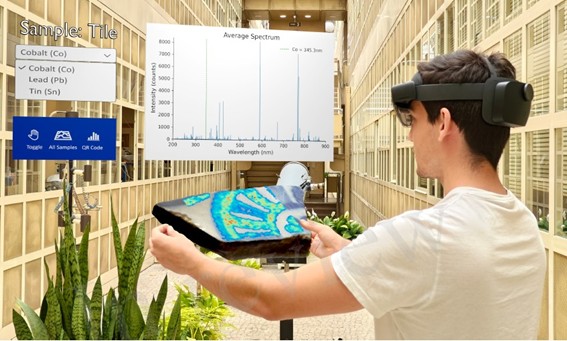
This research line investigates the integration of spectral imaging with immersive visualization technologies, creating intuitive platforms for material diagnostics and contextual analysis. Building on LIBS and photogrammetry, we developed a pipeline that merges 2D spectral maps with 3D surface models, allowing for interactive exploration of chemical composition. Our latest work introduces an augmented reality (AR) interface for the HoloLens 2, enabling gesture-based manipulation and real-time analysis of spectral data overlaid on digital representations of real objects. This human-centered approach to spectral imaging enhances data interpretation, facilitates training, and opens pathways for collaborative, multisensory analysis in both research and operational settings.
Photonic and Spectroscopic Tools for Heritage Conservation
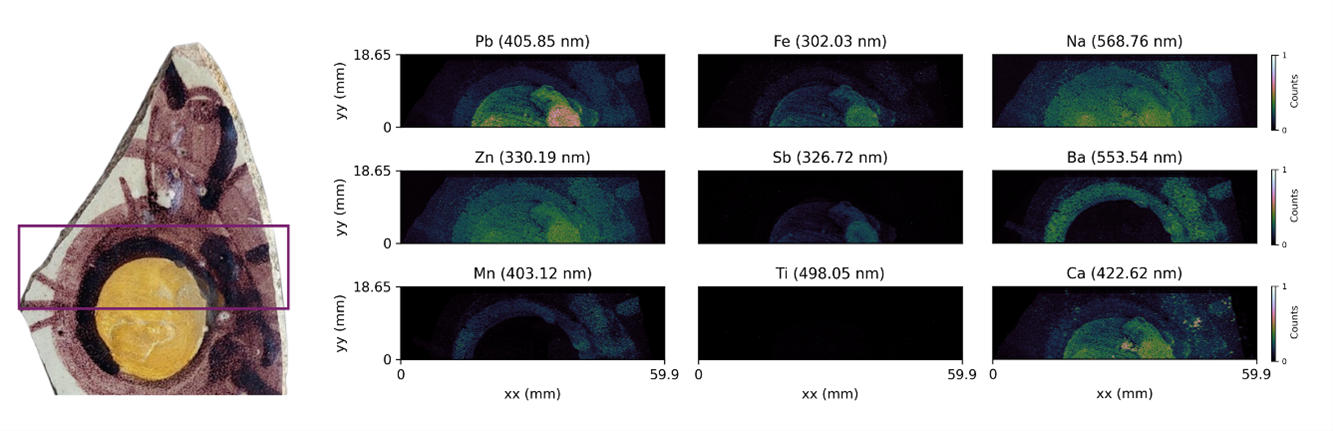
This line focuses on developing minimally invasive diagnostic tools for cultural heritage analysis. Our work combines compact LIBS systems with fiber lasers for in situ chemical mapping of historical artifacts. In a recent study, we demonstrated the ability to characterize 18th-century Portuguese tiles using depth-resolved LIBS with minimal damage, supported by validation through XRF. Looking forward, we aim to integrate these techniques with 3D modeling and spectral visualization pipelines to support the documentation and analysis of complex surfaces such as glazed ceramics, papier-mâché sculptures, and other fragile heritage materials. These efforts will contribute to more sustainable restoration practices and enriched cultural storytelling.
Our Team
Meet the researchers working on Spectral Imaging projects:
Dr. Diana Guimarães
Postdoctoral Researcher
Dr. Nuno A. Silva
Postdoctoral Researcher
Dr. Pedro Jorge
Auxiliary Professor
Diana Capela
PhD Student

Tomás Lopes
PhD Student
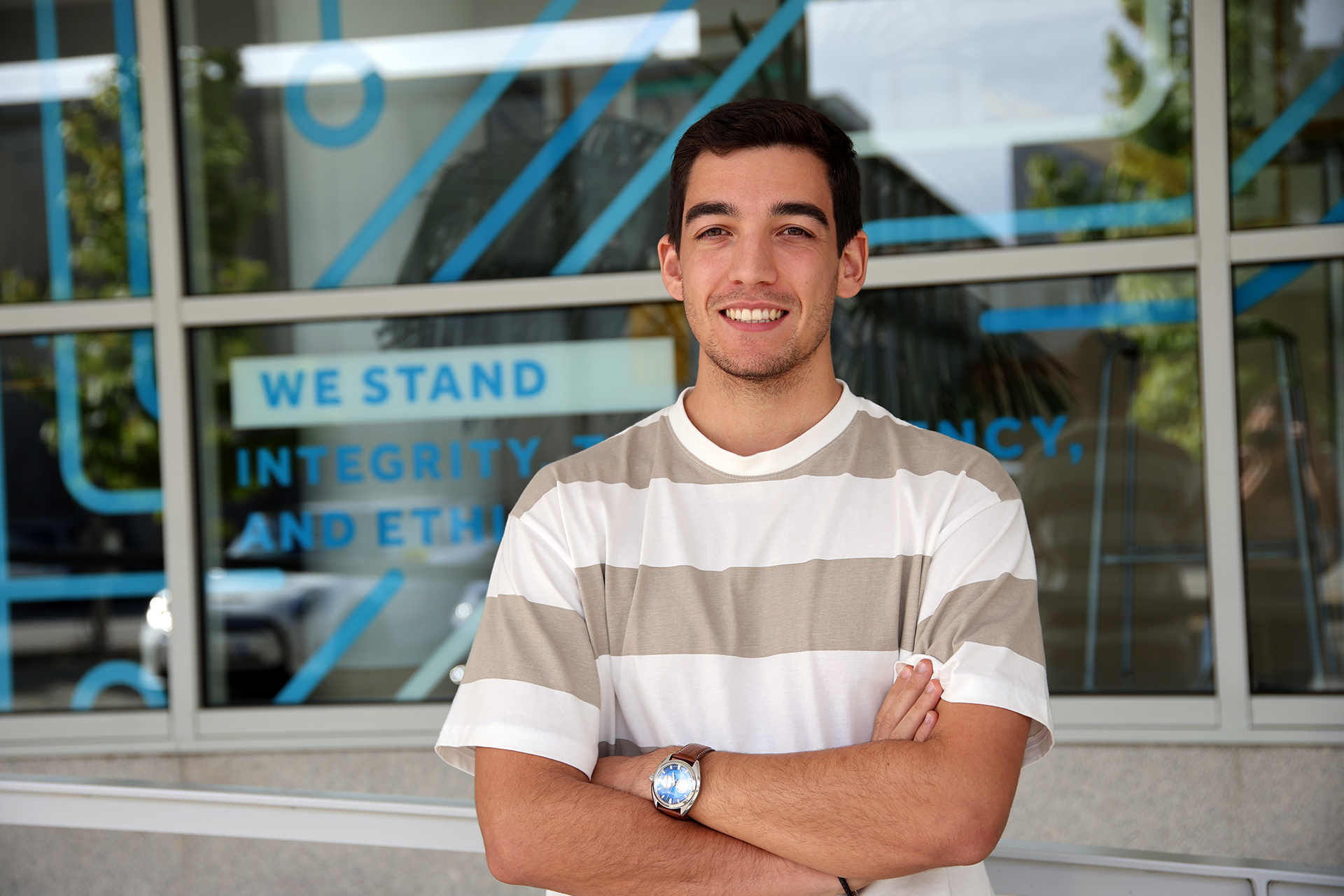
Rafael Cavaco
Master Researcher

João Caramelo
Master Student
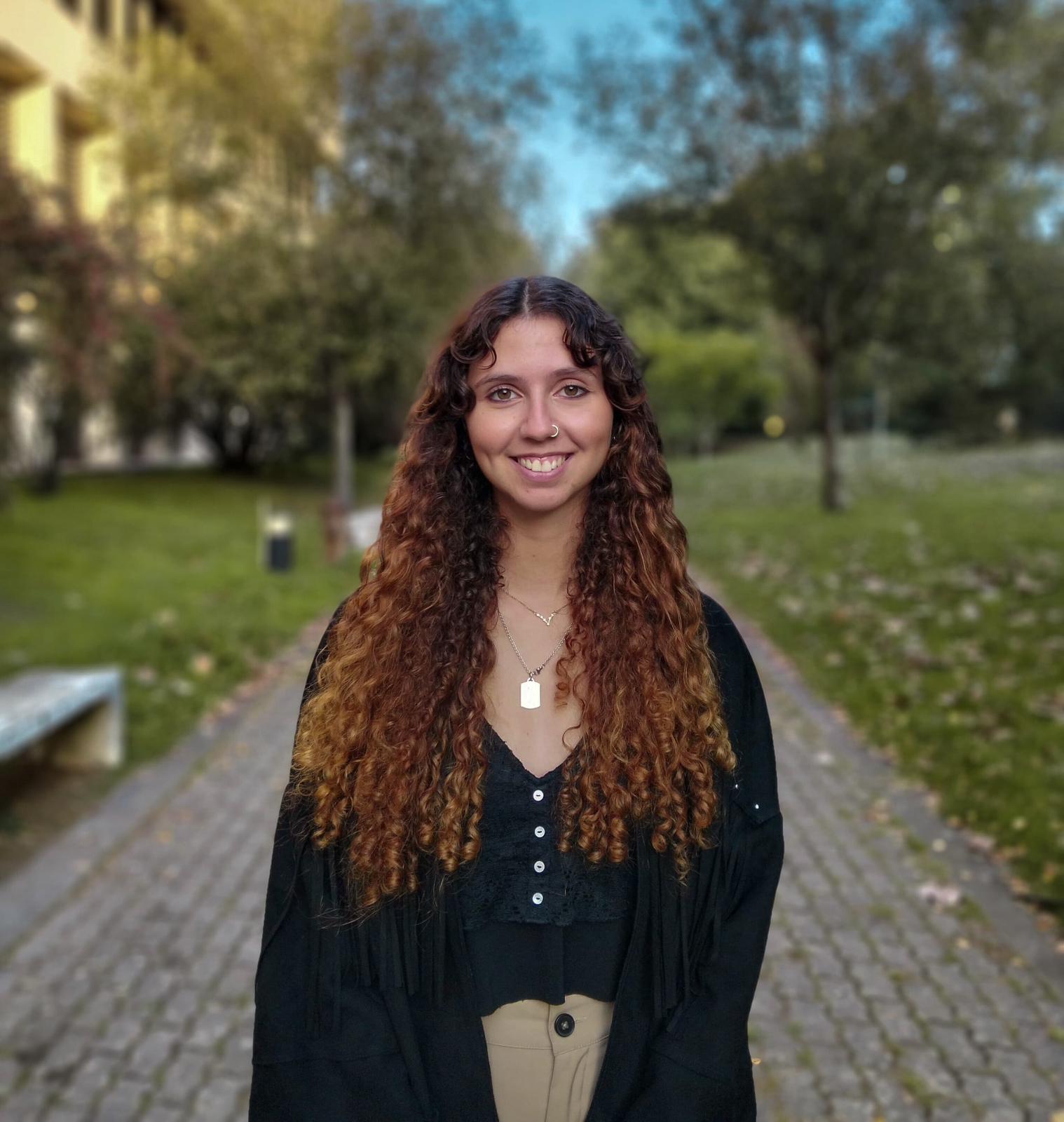
Luana Pereira
Master Student
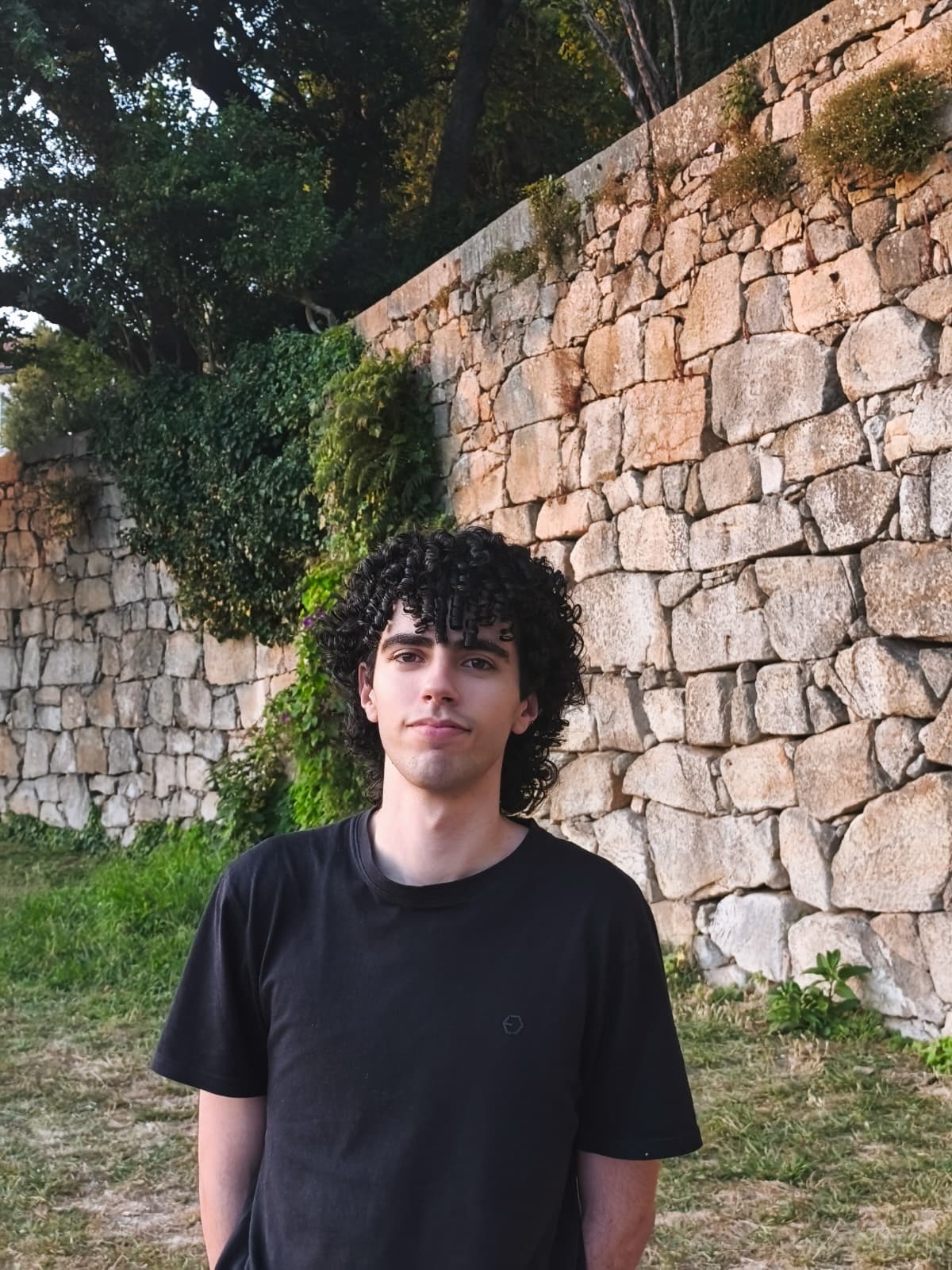
André Rodrigues
Master Student
Past Visiting Researchers
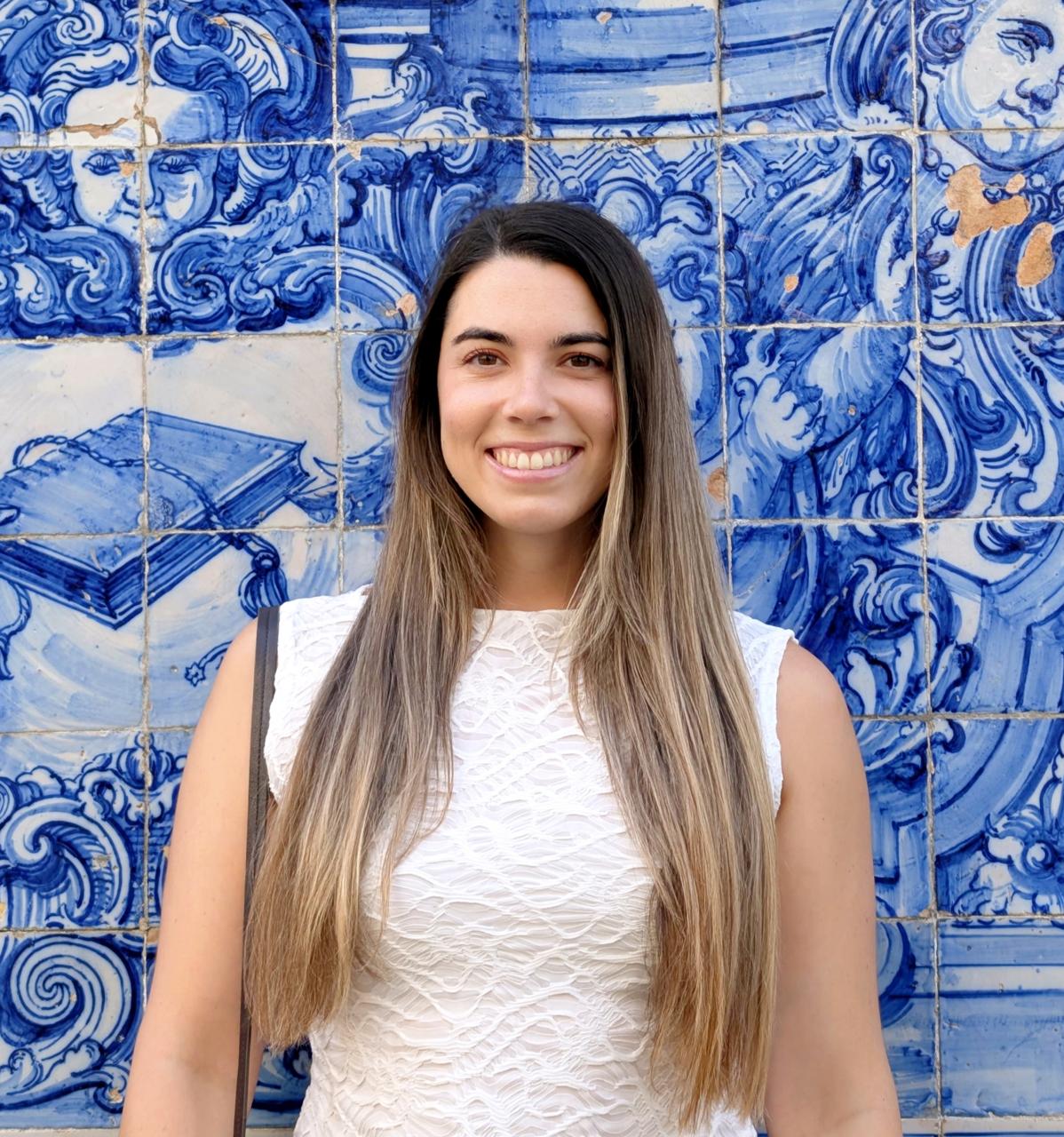
Clara Burgos-Palop
Universidad de Málaga
Visiting Student
Miroslava Seewaldová
Brno University of Technology
Visiting Student
Projects
Loading projects...
Journal Articles
Beyond Human Vision: Unlocking the Potential of Augmented Reality for Spectral Imaging
Applied Sciences • 2025
Laser-Induced Breakdown Spectroscopy for surface analysis of solid-state anode-less battery
Journal of Power Sources • 2025
From waste to resource: LIBS methodology development for rapid quality assessment of recycled wood
Journal of Hazardous Materials • 2025
Advancing automated mineral identification through LIBS imaging for lithium-bearing mineral species
Spectrochimica Acta Part B: Atomic Spectroscopy • 2025
Improving LIBS-based mineral identification with Raman imaging and spectral knowledge distillation
Talanta • 2025
Unsupervised and interpretable discrimination of lithium-bearing minerals with Raman spectroscopy imaging
Heliyon • 2024
From sensor fusion to knowledge distillation in collaborative LIBS and hyperspectral imaging for mineral identification
Scientific Reports • 2024
Identification of Relevant Spectral Ranges in Laser-Induced Breakdown Spectroscopy Imaging Using the Fourier Space
Society for Applied Spectroscopy • 2024
Characterization of Functional Coatings on Cork Stoppers with Laser-Induced Breakdown Spectroscopy Imaging
Sensors • 2023
Robust and interpretable mineral identification using laser-induced breakdown spectroscopy mapping
Spectrochimica Acta Part B: Atomic Spectroscopy • 2023
Interactive three-dimensional chemical element maps with laser-induced breakdown spectroscopy and photogrammetry
Spectrochimica Acta Part B: Atomic Spectroscopy • 2023
Intelligent grids for faster elemental mapping with Laser-induced breakdown spectroscopy
Results in Optics • 2023
Comprehensive comparison of linear and non-linear methodologies for lithium quantification in geological samples using LIBS
Spectrochimica Acta Part B: Atomic Spectroscopy • 2022
Towards robust calibration models for laser-induced breakdown spectroscopy using unsupervised clustered regression techniques
Results in Optics • 2022
TX-ray Fluorescence and Laser-Induced Breakdown Spectroscopy Analysis of Li-Rich Minerals in Veins from Argemela Tin Mine, Central Portugal
Minerals • 2021
PhD Thesis
Laser-induced breakdown spectroscopy: Innovative software tools to bridge the gap between science and technology
University of Porto • Expected 2027
Development of Laser-Induced Breakdown Spectroscopy Systems for Industrial Applications
University of Porto • 2024
Master Theses
Spectrally-Enhanced 3D Reconstruction of Heritage Samples Using LIBS, XRF, and Raman Spectroscopy
University of Porto • Expected 2026
Automation And Sample Classification Algorithms For Industrial Spectroscopy-Based Systems
University of Porto • 2025
Laser Induced Breakdown Spectroscopy (LIBS) as a robust analytical tool for geological samples
University of Porto • 2020
Optimization of Laser Induced Breakdown Spectroscopy (LIBS) for application in the cork industry
University of Porto • 2020
Intelectual Property
SpectraLKD - Method and system for classification of samples using multimodal spectral knowledge distillation
PT118897, PCT/IB2024/050498 • 2023
Awards
Best Poster Award - Minimizing LIBS Damage in the Analysis of Historical Tiles using Adaptive Color-Clusters
International Symposium on Advanced Measurement, Analysis and Control for Energy and Environment, Brno, Czech Republic • 2025
PhD Best Poster Award - Fiber Laser LIBS as a Sensing Tool for Chemical Mapping of Heritage Tiles
ESP Young Minds U. Porto Poster Contest 2025 • 2025
BIP Proof Award - Multimodal architecture and knowledge distillation for high performance spectroscopy
U. Porto Inovação • 2023
Element search optimization in LIBS spectra of geological samples
Best poster of Optic and Lasers area in FÍSICA 2020, 22º Conferência Nacional de Física and 30º Encontro Ibérico para o Ensino da Física • 2020